Branson: Top of the Rock Ozarks Heritage Preserve
5.0(1326)
From$36
Branson: Top of the Rock Ozarks Heritage Preserve
5.0 (1,326)
From$36per person


NYC: 9/11 Memorial & Museum Timed Ticket with Tour Options
Visiting New York City is often associated with skyscrapers, bright lights, Broadway shows, famous neighborhoods, and unforgettable views. Yet beneath the energy of Manhattan lies a place of profound remembrance: the National September 11 Memorial & Museum at the World Trade Center site. This experience invites visitors to pause, reflect, and learn about the events of September 11, 2001, while remembering the people whose lives were lost and discovering stories of courage, resilience, and human strength.
With a pre-purchased timed-entry ticket, you can enter the 9/11 Memorial Museum and explore its exhibitions at your own pace. Your visit also includes complimentary access to the 9/11 Memorial, the Survivor Tree, and the Memorial Glades. Together, these spaces create an experience that combines history, remembrance, architecture, personal stories, and reflection in the heart of Lower Manhattan.
The experience is designed for travelers who want to understand an important chapter of New York and world history rather than simply pass by the World Trade Center site. Inside the museum, more than 10,000 monumental artifacts connected with the events of 9/11 help tell a complex and deeply human story. The exhibitions explore what happened on September 11, the events leading up to that day, and the consequences that followed.
Outside, the 9/11 Memorial provides a quieter environment for remembrance. The twin reflecting pools occupy the footprints where the Twin Towers once stood, while the names of those who died in the 2001 and 1993 attacks are inscribed around the pools. The setting encourages visitors to slow down, observe, and reflect on the human stories behind the historical events.
A visit to the 9/11 Memorial & Museum is different from a conventional sightseeing attraction. Instead of focusing primarily on entertainment, panoramic views, or architectural spectacle, this experience centers on memory and understanding.
As you arrive in Lower Manhattan, the surrounding city continues moving at its familiar pace. People walk between office buildings, visitors explore nearby attractions, and the streets remain filled with the energy that defines New York City. Within the World Trade Center site, however, the atmosphere changes.
The memorial pools create a powerful sense of space and reflection. Water continuously flows downward into the large square pools, surrounded by bronze panels carrying the names of people who lost their lives. The pools stand within the former footprints of the Twin Towers, connecting the present-day city with a place that became central to modern history.
For many travelers, this is the first moment when the scale of the events becomes more personal. Names, places, dates, photographs, objects, and individual stories can transform an event learned about through books or news reports into something much more human.
The museum continues that journey indoors.
The National September 11 Memorial Museum provides an extensive historical and memorial experience at the World Trade Center site. Its exhibitions use artifacts and personal stories to explore the events surrounding September 11 and their lasting impact. The museum currently presents three permanent exhibition areas: the Historical Exhibition, the Memorial Exhibition known as “In Memoriam,” and Foundation Hall.
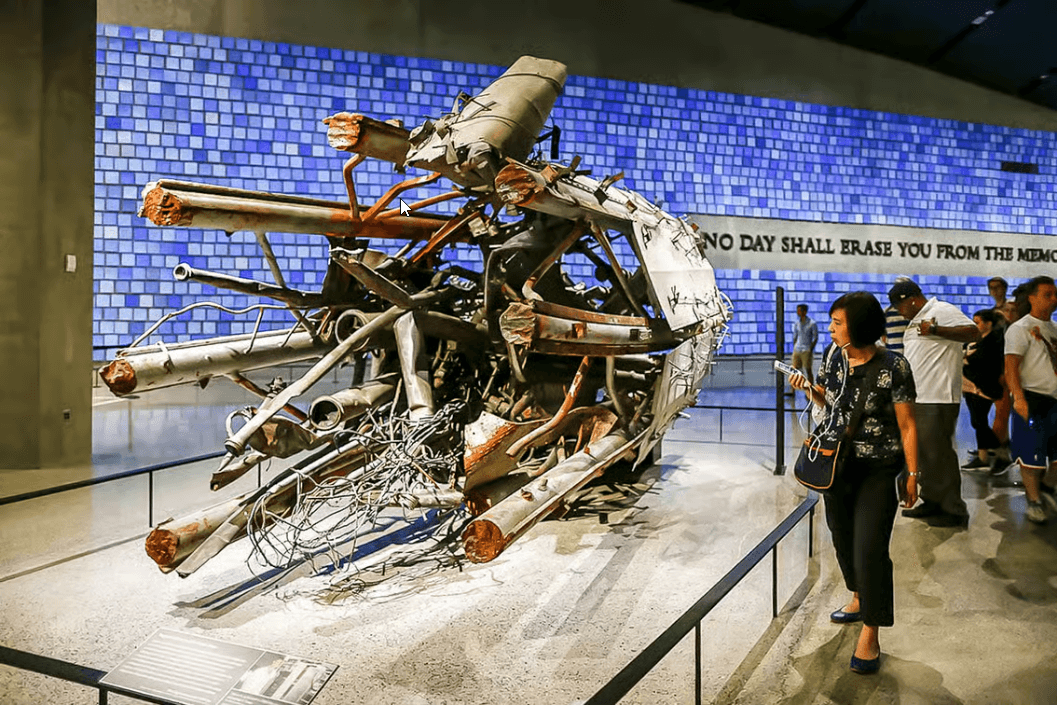
The museum displays more than 10,000 monumental artifacts associated with the events of 9/11. These objects provide tangible connections to the people, places, and circumstances surrounding the attacks. Rather than experiencing history only through written descriptions, visitors encounter physical evidence preserved within the museum environment.
The Historical Exhibition is organized into three sections: “Before 9/11,” “The Day of 9/11,” and “After 9/11.” Together, they provide a chronological framework for understanding the events and their broader context.
The exhibition explores what happened at the World Trade Center and also places the events within the wider story of September 11, including the attacks at the Pentagon and the story of Flight 93.
For travelers visiting New York for the first time, this section can provide important context for understanding why the World Trade Center site holds such significance. For visitors who remember the events themselves, the experience can provide another opportunity to revisit the history through preserved objects, documentation, and personal stories.
The exhibition is not simply about a single day. By examining what came before and what followed, it provides a broader perspective on how historical events can affect communities, cities, families, and societies over time.
The Memorial Exhibition focuses directly on the people who lost their lives.
“In Memoriam” commemorates those killed in the September 11, 2001 attacks and the February 26, 1993 World Trade Center bombing. It gives visitors an opportunity to learn more about the men, women, and children whose lives were lost.
This part of the museum can make the experience especially personal. Historical events can sometimes feel distant when presented only through dates and statistics. Here, the emphasis on individual lives reminds visitors that behind every historical account were real people with families, relationships, work, ambitions, and stories.
For many travelers, taking time in this exhibition becomes one of the most reflective parts of their visit.
Foundation Hall is another major part of the museum experience. The enormous space contains two significant elements: the Last Column and the slurry wall.
The scale of Foundation Hall helps visitors understand the physical dimensions of the World Trade Center site and the extraordinary structures that existed beneath and around it. It provides a powerful architectural and historical connection between the museum and the original site.
Rather than being simply another gallery, the hall contributes to the larger atmosphere of remembrance and preservation that defines the museum.
The 9/11 Memorial is located outside the museum and is included with the experience. Visitors can access the memorial, Survivor Tree, and Memorial Glades without an additional admission charge as part of the listed experience.
The memorial honors the nearly 3,000 people killed in the September 11, 2001 attacks at the World Trade Center site and the Pentagon, as well as the six people killed in the February 1993 World Trade Center bombing.
Its centerpiece is formed by two enormous reflecting pools positioned within the footprints of the former Twin Towers.
Each pool is nearly an acre in size, and each features a large waterfall descending into the center. The waterfalls are described by the attraction as the largest manmade waterfalls in North America. Bronze panels surrounding the pools carry the names of those who died in the attacks.
The combination of water, architecture, names, and open space creates a setting that encourages quiet reflection.
One of the most recognizable elements of the memorial grounds is the Survivor Tree.
The tree survived the destruction of the World Trade Center site and was later cared for and returned to the memorial grounds. Today, it represents survival and renewal within a place dedicated to remembrance.
For visitors walking through the memorial, the tree provides a natural contrast to the surrounding architecture. Its presence adds another layer to the experience, connecting the themes of loss and remembrance with ideas of endurance and renewal.
The Survivor Tree is included among the areas accessible with this experience.
One of the defining elements of this New York experience is its focus on personal stories.
The events of September 11 are frequently discussed through historical dates, major locations, political developments, and worldwide consequences. The museum provides another perspective by preserving personal stories and artifacts connected to the people affected by the attacks.
This human dimension can change the way visitors experience the site.
Instead of simply asking what happened, visitors are encouraged to consider the people who experienced the events, the people who responded, the families who were affected, and the communities that continued afterward.
For travelers, this can make the visit both educational and emotional.
It is also an opportunity to understand why the World Trade Center site remains an important place of remembrance more than two decades after the attacks.
The World Trade Center site is deeply connected with the identity of modern New York City. Visiting the 9/11 Memorial & Museum allows travelers to experience a major historical site while physically standing in the location where many of the events unfolded.
The surrounding Lower Manhattan neighborhood has continued to evolve, but the memorial and museum preserve important elements of the site's history.
This makes the experience particularly valuable for visitors interested in New York history, American history, architecture, museums, cultural tourism, and significant historical landmarks.
Rather than viewing the city only through its famous attractions, travelers can use this visit to understand another dimension of New York: its history, its people, its changing skyline, and its capacity to preserve memories of difficult events.
A major advantage of this activity is the combination of timed museum admission and access to the outdoor memorial spaces.
Your pre-purchased timed-entry ticket allows you to enter the 9/11 Memorial Museum during your selected time. The experience also provides access to the museum's current exhibitions, while the 9/11 Memorial, Survivor Tree, and Memorial Glades are included at no additional admission cost.
The ticket also offers contactless entry, making the arrival process straightforward once you reach the attraction. Visitors should be prepared to pass through airport-style security before entering.
Depending on the option selected, different tour formats may be available. The product page lists options that can include the standard timed-entry experience, family value bundles, an early-access museum tour, a museum guided tour, and FLEX entry. Meeting arrangements can vary according to the option booked.
This flexibility means travelers can select an experience that fits their New York itinerary and preferred style of exploration.
The 9/11 Memorial & Museum is particularly relevant for travelers who enjoy meaningful cultural experiences.
If your ideal New York itinerary includes historic landmarks, museums, architecture, and places that help you understand the city's past, this experience provides an important addition.
It can also complement a broader Lower Manhattan sightseeing day. The World Trade Center area is surrounded by major attractions and historic neighborhoods, making it possible to incorporate the memorial and museum into a wider exploration of downtown Manhattan.
However, because the museum contains emotionally difficult historical material, visitors should allow themselves enough time and space to process the experience rather than treating it as a rushed stop between other attractions.
Although the listed ticket is valid for one day, the experience is best approached without unnecessary rushing.
The museum contains multiple permanent exhibitions, thousands of artifacts, memorial spaces, and historical information. Travelers who want to understand the exhibitions more fully should plan their visit around their own interests and pace.
Some visitors may spend more time with the Historical Exhibition, while others may find the Memorial Exhibition particularly meaningful. Foundation Hall provides another important part of the museum experience, with its monumental architectural elements.
Taking your time allows the visit to become more than simply checking an attraction off your New York itinerary.
It becomes an opportunity to learn.
New York City offers countless attractions, but not every attraction provides the opportunity to connect with history in such a direct way.
A visit to the 9/11 Memorial & Museum can become one of the most memorable parts of a trip because it asks visitors to pause amid the energy of Manhattan and reflect on a defining moment in modern history.
The experience begins with the physical location.
You stand within the footprints of the former Twin Towers.
You see the reflecting pools.
You encounter the names engraved around the memorial.
You see the Survivor Tree.
Then, inside the museum, you encounter artifacts and exhibitions that expand the historical story.
The progression from outdoor memorial to indoor museum creates a natural journey from remembrance toward understanding.
The 9/11 Memorial & Museum should not be viewed simply as another New York City attraction.
It is a place where history, memory, architecture, personal stories, and public remembrance come together.
For international visitors, the museum can provide context about an event that affected people far beyond New York and the United States. For domestic travelers, it offers an opportunity to revisit a pivotal moment in American history. For families, the experience can create opportunities for thoughtful conversations about history and remembrance, subject to each family's judgment about the age and sensitivity of individual travelers.
For students, educators, history enthusiasts, and cultural travelers, the museum's exhibitions offer a substantial collection of material through which to explore the events and their consequences.
For anyone visiting Lower Manhattan, the memorial provides a place to stop, reflect, and remember.
Because the experience is located at the World Trade Center site, it can naturally fit into a day exploring Lower Manhattan.
Travelers can plan time around their selected museum entry. Since the ticket is timed, arriving prepared for the scheduled admission time can help keep the rest of the day's itinerary organized.
The museum requires security screening, so visitors should allow time for the entry process. Airport-style security is currently required for all visitors.
The museum also has coat-check facilities, interactive exhibit components, and an on-site café for visitors. Audio guide rentals are available for purchase at the museum.
These facilities can make it easier to spend meaningful time exploring the site without needing to leave immediately for basic visitor needs.
Some travel memories are created by spectacular views.
Others are created by the stories you hear and the places that make you stop and think.
The 9/11 Memorial & Museum belongs to the second category.
You may remember the quiet sound of the memorial waterfalls. You may remember reading names around the reflecting pools. You may remember seeing artifacts preserved from the events. You may remember the enormous Foundation Hall or the Survivor Tree. You may remember a personal story that changed the way you understood an event you had previously known only through history.
Every visitor's experience can be different.
That is part of what makes a memorial museum meaningful.
One of the most important aspects of the museum is its attention to individuals.
Large historical events can sometimes be reduced to statistics. The Memorial Exhibition provides a different perspective by commemorating the lives of those who died in both the September 11, 2001 attacks and the February 1993 World Trade Center bombing.
This focus helps preserve personal memory alongside historical documentation.
Visitors can therefore approach the museum not only as a place to learn about what happened, but also as a place to recognize the people behind the history.
That distinction can make the experience particularly powerful.
The design of the memorial itself contributes to the visitor experience.
The twin reflecting pools occupy the exact footprints of the former towers, creating a physical relationship between the memorial and the history of the site. The surrounding names, water, open plaza, and Survivor Tree create a carefully considered environment for remembrance.
The architecture does not simply provide a backdrop.
It becomes part of the story.
Visitors can understand the scale of the former World Trade Center site while simultaneously experiencing the calm atmosphere of the memorial.
This combination of space and symbolism makes the 9/11 Memorial an important destination for travelers interested in architecture and memorial design as well as history.
For visitors planning a multi-day New York vacation, the 9/11 Memorial & Museum can serve as a meaningful cultural stop during a Lower Manhattan day.
Rather than spending an entire day moving from one attraction to another without pause, travelers can create an itinerary that includes time for history and reflection.
The location also makes it practical to explore other parts of downtown Manhattan before or after the visit, depending on opening times, ticket selections, and the rest of your travel plans.
Because this is a historical memorial and museum rather than a conventional entertainment attraction, planning enough time for the experience is important.
This experience can appeal to a wide range of travelers, particularly:
Travelers interested in modern history can explore the events of September 11 through permanent exhibitions, artifacts, and documentation.
Visitors looking for experiences that go beyond New York's famous entertainment and shopping districts can discover an important cultural and historical site.
The museum contains extensive exhibitions and more than 10,000 monumental artifacts connected to the events of 9/11.
The memorial's reflecting pools, the preserved elements of Foundation Hall, and the overall relationship between architecture and remembrance make the site significant from a design perspective.
For travelers visiting Manhattan for the first time, the memorial provides context for understanding an important part of the city's recent history.
Even travelers who have previously visited the city may find the museum offers a different perspective on Lower Manhattan and its transformation over time.
The 9/11 Memorial & Museum deals with death, destruction, loss, and the consequences of terrorism. Visitors should therefore approach the experience with appropriate respect and awareness.
The emotional response can vary considerably from one person to another.
Some visitors may find the historical exhibitions fascinating and educational. Others may find certain displays deeply moving. The experience may be especially personal for visitors with direct or family connections to the events.
There is no single way to experience a memorial.
The important part is allowing yourself the space to engage with the material at your own pace.
The product currently provides a timed-entry ticket to the 9/11 Memorial Museum and access to the museum's current exhibitions. Access to the 9/11 Memorial, Survivor Tree, and Memorial Glades is included without a separate admission charge. Free Wi-Fi is also listed as included.
All visitors must pass through airport-style security before entering the museum.
The museum currently states that all museum spaces and exhibitions are open to the public. Coat-check facilities, interactive exhibit components, and an on-site café are also available. Audio guide rentals can be purchased separately at the museum.
The activity does not include a guided tour or audio guide as a standard inclusion for the basic ticket. The product page lists guided tours among options and states that an audio guide is available for purchase. Travelers should therefore check the exact option selected when booking.
The most meaningful way to approach this experience is as a journey.
Begin outside at the memorial.
Pause beside the reflecting pools.
Take time to read the names.
Observe the Survivor Tree.
Then enter the museum and explore the historical exhibitions.
Move through the story of what happened before, during, and after September 11.
Learn about the individuals who lost their lives.
See the preserved artifacts.
Stand within Foundation Hall.
Allow the different elements of the museum to connect the larger historical narrative with the individual human stories behind it.
By the end of the visit, you may have gained more than historical information. You may have a deeper understanding of why the World Trade Center site continues to hold such importance for New York City and for visitors from around the world.
New York is a city built around movement, change, ambition, and reinvention. The 9/11 Memorial & Museum provides a place where visitors can pause within that constantly changing city and remember a moment that transformed New York and had consequences around the world.
The memorial preserves the memory of those who were lost.
The museum preserves artifacts and historical evidence.
The exhibitions preserve stories.
The Survivor Tree represents continued life at a site marked by immense loss.
Together, these elements create an experience centered on remembrance, education, and resilience.
For travelers seeking a deeper understanding of New York City, the 9/11 Memorial & Museum offers an opportunity to step beyond conventional sightseeing and connect with one of the most significant chapters in the city's modern history.
A trip to New York City can be filled with iconic experiences, but the places that remain with travelers longest are often those that create an emotional connection.
At the 9/11 Memorial & Museum, the experience is not about rushing from one attraction to another.
It is about slowing down.
It is about looking closely.
It is about learning.
It is about remembering.
It is about recognizing the individual human stories behind a historical event.
With timed museum admission, access to the memorial grounds, the Survivor Tree, Memorial Glades, and the museum's permanent exhibitions, this experience provides a structured way to explore the World Trade Center site's history while allowing visitors time for personal reflection.
Whether you are visiting New York for the first time or returning to the city for another adventure, the 9/11 Memorial & Museum can provide a meaningful perspective on Lower Manhattan and the history that shaped it.
The National September 11 Memorial & Museum is ultimately a place where history becomes personal.
The reflecting pools mark the footprints of the Twin Towers.
The names preserve the memory of those who died.
The exhibitions document what happened.
The artifacts connect visitors with the physical reality of the events.
The personal stories reveal the human dimension.
The Survivor Tree offers a visible symbol of survival and renewal.
And the museum's spaces give visitors room to consider the past while standing in the heart of a continually evolving New York City.
For travelers searching for a significant historical experience in Manhattan, this timed-entry visit offers a chance to explore the 9/11 Memorial Museum and pay respects at the memorial itself.
Come prepared to learn, reflect, and remember.
Experience one of New York City's most important sites of remembrance and discover the stories, artifacts, people, and places that continue to shape the history of the World Trade Center site.
A visit to the 9/11 Memorial & Museum is best approached with time, attention, and respect. The experience combines an outdoor memorial with an extensive indoor museum, allowing travelers to explore the history of September 11, 2001 and the February 1993 World Trade Center bombing through architecture, artifacts, exhibitions, and personal stories.
Your experience begins with the timed-entry admission selected during booking. Choosing a scheduled entry time helps you organize your Lower Manhattan itinerary around the museum visit. Because security screening is required before entering the museum, arriving with enough time to complete the entry process is an important part of planning your day.
Once inside, you can explore the permanent exhibitions at your own pace. Rather than following a conventional sightseeing route, consider allowing yourself time to stop at displays that interest you, read individual stories, and absorb the historical information presented throughout the museum.
After exploring the museum, you can spend additional time at the outdoor memorial spaces, including the reflecting pools, Survivor Tree, and Memorial Glades.
The experience combines several distinct elements into one meaningful New York City visit.
Your selected ticket provides admission to the 9/11 Memorial Museum at a scheduled time. This gives you access to the museum's permanent exhibitions and collection of artifacts connected with September 11. (getyourguide.com)
The outdoor memorial is accessible as part of the experience. Its two reflecting pools occupy the footprints of the former Twin Towers, creating a powerful architectural memorial in the heart of Lower Manhattan. (getyourguide.com)
The Survivor Tree is another important part of the memorial grounds. Its history and continued presence provide a connection between the destruction of the World Trade Center site and the renewal that followed.
The Memorial Glades form part of the outdoor memorial landscape and are included with the experience.
The museum's permanent exhibitions include the Historical Exhibition, the Memorial Exhibition, and Foundation Hall. Together, they provide different perspectives on the events and their human consequences. (getyourguide.com)
The museum collection includes more than 10,000 monumental artifacts related to the events of 9/11. These physical objects contribute to the museum's historical narrative and help visitors connect with the events through tangible evidence. (getyourguide.com)
The Historical Exhibition is structured around three major periods: before 9/11, the day of 9/11, and the aftermath.
This structure allows visitors to understand the event as a historical process rather than as an isolated moment.
The first part provides context for the events that occurred on September 11, 2001.
Understanding historical context can help visitors appreciate the complexity surrounding the attacks and the international circumstances connected to them.
The second section focuses on the events of September 11 itself.
Visitors can explore documentation and artifacts connected with the attacks at the World Trade Center and the other locations targeted that day.
The final section considers the aftermath and the consequences that followed.
This broader perspective is important because the significance of September 11 extends beyond the events of a single day. The attacks affected families, communities, New York City, the United States, and people around the world.
The Historical Exhibition provides a framework for understanding these developments.
The “In Memoriam” exhibition focuses on the people who died in the September 11, 2001 attacks and the February 1993 World Trade Center bombing. (getyourguide.com)
This section of the museum creates an opportunity to move away from broad historical narratives and focus on individual lives.
For many visitors, this is a deeply personal part of the museum.
Take your time.
Read the information available.
Remember that every name represents a person whose absence affected families, friends, colleagues, and communities.
The memorial's emphasis on individual lives helps create a human connection to events that are otherwise often discussed through dates, numbers, and headlines.
Foundation Hall provides a different perspective on the World Trade Center site.
The large space contains the Last Column and the slurry wall, two significant surviving elements connected with the original World Trade Center complex. (getyourguide.com)
The scale of the room can help visitors appreciate the engineering and physical dimensions of the former site.
The Last Column also carries considerable historical significance because of its association with recovery and the conclusion of the search and recovery effort at Ground Zero.
Foundation Hall therefore contributes to both the architectural and historical aspects of the museum.
Although the ticket provides flexibility to explore the museum, a thoughtful sequence can help you make the most of your visit.
Plan to reach the World Trade Center area before your scheduled museum entry.
This gives you time to orient yourself, locate the entrance, and prepare for security screening.
All museum visitors must pass through airport-style security. (getyourguide.com)
Keep this requirement in mind when planning your arrival.
Once admitted, begin exploring the permanent exhibitions.
You do not need to rush through the displays. Read the information that interests you and allow yourself time to reflect.
Consider beginning with the Historical Exhibition if you want a chronological understanding of the events.
Its “Before 9/11,” “Day of 9/11,” and “After 9/11” structure provides a useful historical framework.
Continue to the Memorial Exhibition to learn about the individuals whose lives were lost.
This can be one of the most reflective portions of the visit.
Spend time with the major architectural elements preserved in Foundation Hall, including the Last Column and slurry wall.
After exploring the museum, head outside and visit the reflecting pools, Survivor Tree, and Memorial Glades.
This creates an opportunity to experience the memorial without the same enclosed museum environment.
Before leaving, consider taking a few minutes simply to observe the memorial.
There is no need to rush.
The atmosphere of the site encourages reflection.
The museum contains extensive exhibitions and a large collection of artifacts. The exact amount of time each visitor needs will depend on their interests and pace.
Travelers who want to read extensively and explore the exhibitions carefully should plan accordingly.
Do not schedule the museum so tightly between other attractions that you feel pressured to leave before you have finished exploring.
Airport-style security screening is required for visitors entering the museum. (getyourguide.com)
Allowing extra arrival time can make your experience more comfortable.
The product offers several ticket and tour options, including timed-entry admission and options involving guided tours or different entry arrangements. The exact inclusions can vary by option. (getyourguide.com)
Always review the specific option you select at the time of booking.
The exhibitions address terrorism, death, destruction, loss, and the experiences of people affected by the attacks.
Travelers should consider whether the content is appropriate for everyone in their group, especially younger children.
The standard experience information lists the following key inclusions:
The exact inclusions depend on the ticket option selected. (getyourguide.com)
Some optional services are not included with the basic ticket.
The product information indicates that the following may not be included in the standard admission:
An audio guide can be purchased separately at the museum, while guided-tour access depends on the option booked. (getyourguide.com)
Because tour options and pricing can change, travelers should verify the exact inclusions displayed for their selected ticket before completing the booking.
The product page provides several ways to experience the 9/11 Memorial & Museum.
Depending on availability, travelers may encounter options such as:
A straightforward option for travelers who prefer to explore the museum independently.
A package designed around families and groups traveling together.
An option for travelers who want an earlier museum experience and a more structured visit.
A guided option for visitors who prefer additional interpretation during their museum experience.
An option providing additional flexibility around museum entry, subject to the terms displayed at booking.
Because availability, prices, schedules, and specific terms can change, always review the current option details before purchasing.
The museum uses timed admission, so planning ahead is useful, especially when visiting New York during busy travel periods.
Booking in advance can help you build the rest of your Lower Manhattan itinerary around your museum entry.
Do not treat your entry time as the moment you should begin walking toward the museum.
Give yourself time to reach the site and complete security screening.
The museum and surrounding Lower Manhattan area can involve substantial walking.
Comfortable footwear can make your overall sightseeing day easier.
The memorial is outdoors, so weather conditions can affect part of your visit.
In summer, comfortable clothing and sun protection can be useful. In colder months, dress appropriately for spending time outdoors around the memorial pools.
If you are primarily interested in history, allow more time for the Historical Exhibition.
If memorial experiences are your main reason for visiting, make sure you leave enough time for the outdoor memorial and “In Memoriam” exhibition.
This is a memorial site.
Visitors should behave respectfully and be considerate of others who may be experiencing the site in a deeply personal way.
Opening procedures, ticket options, security requirements, accessibility arrangements, and other visitor policies can change.
Review the current information associated with your selected ticket before traveling.
Families can visit the 9/11 Memorial & Museum, but parents and guardians should consider the sensitive nature of the material.
The museum addresses terrorism, death, destruction, and personal loss. Some displays may be emotionally difficult for younger visitors.
Parents can decide how much of the exhibition material is appropriate for their children and can prepare them beforehand by explaining that the museum is a place for learning and remembrance.
The experience can also provide an opportunity for age-appropriate conversations about history, empathy, courage, and remembrance.
Because families vary considerably, there is no single age at which the experience becomes appropriate for every child.
The visit can be incorporated into a New York itinerary for older travelers, but the amount of walking and standing should be considered.
The museum and memorial are extensive, and visitors may spend considerable time moving between exhibitions.
Seniors who prefer a slower pace can plan additional time and take breaks as needed.
Comfortable shoes and appropriate seasonal clothing are particularly useful.
Travelers with specific accessibility or mobility requirements should review the current accessibility information before booking.
There is no special dress code for visiting the museum and memorial, but respectful, comfortable clothing is appropriate.
Because the outdoor memorial forms part of the experience, consider the weather when choosing what to wear.
Comfortable walking shoes are recommended for a full Lower Manhattan sightseeing day.
During warmer months, lightweight clothing and protection from the sun may be useful. During colder weather, a warm outer layer is advisable because the memorial is outdoors.
The museum itself provides an indoor experience, but the memorial grounds are outdoors.
Rain may affect how long you wish to spend around the reflecting pools and other exterior areas.
If weather conditions are poor, visitors can prioritize the indoor museum exhibitions and visit the outdoor memorial when conditions are more comfortable, subject to the attraction's current access policies.
Checking the weather forecast before your visit can help you prepare.
Visitor facilities are available at the museum, and the attraction provides other amenities designed to support visitors spending time at the site.
Because facility availability and locations can change, visitors who need specific accessibility or restroom arrangements should confirm current information with the attraction before traveling.
Food and drinks are not generally included with the admission ticket.
The museum currently has an on-site café, providing an option for visitors who want refreshments during their visit. (getyourguide.com)
You can therefore plan your visit around the museum and surrounding Lower Manhattan dining options.
If you are building a full-day downtown itinerary, consider allowing time for a meal before or after your museum visit.
The 9/11 Memorial & Museum is designed as a major public museum and memorial site, and accessibility information is available for visitors who require accommodations.
Travelers with mobility requirements should check the latest official visitor guidance before their visit because accessibility procedures, entrances, services, and temporary restrictions can change.
If someone in your group requires a particular accommodation, confirming the details before arrival can make the experience more comfortable.
The 9/11 Memorial is a place of remembrance, so visitors should use appropriate judgment when taking photographs.
While photography may be possible in permitted areas, the presence of names, memorial spaces, and other visitors means that respectful behavior is especially important.
Avoid treating the memorial simply as a photo opportunity.
Instead, consider photography as secondary to the purpose of the site: remembrance and reflection.
A timed-entry museum visit offers a practical way to organize a New York sightseeing itinerary.
Lower Manhattan contains many attractions, and having a defined museum entry time can help travelers structure their day.
You can plan transportation and surrounding sightseeing around the scheduled admission rather than arriving without a clear plan.
For travelers who want to explore independently, timed entry also provides the freedom to experience the exhibitions according to personal interests.
If you prefer interpretation from a guide, selected ticket options may provide guided experiences.
This makes it possible to choose an approach that matches your travel style.
New York has an extraordinary collection of museums and landmarks, but the 9/11 Memorial & Museum occupies a unique place within the city.
It is simultaneously:
The experience therefore appeals to more than one type of traveler.
History enthusiasts can explore the historical exhibitions.
Museum lovers can examine the artifact collection.
Architecture enthusiasts can study the memorial and preserved structural elements.
Cultural travelers can learn about a defining chapter of New York history.
Families can approach the site as an opportunity for age-appropriate historical learning.
International travelers can gain additional context about an event with worldwide consequences.
Planning your 9/11 Memorial & Museum visit in advance can offer several practical advantages.
A selected entry time gives you a clear starting point for your museum visit.
You can arrange other Lower Manhattan activities around the museum appointment.
Depending on availability, travelers may choose among different admission and tour formats.
A standard admission option allows travelers to experience the exhibitions at their own pace.
The experience also includes access to the outdoor memorial spaces associated with the site. (getyourguide.com)
Imagine beginning your morning among the streets of Lower Manhattan.
The city is already moving around you.
People are heading to work.
Visitors are exploring the downtown streets.
Then you arrive at the World Trade Center site.
The atmosphere changes.
You approach the memorial pools and see the water descending into the enormous square openings.
Around you are the names of people who died.
Nearby stands the Survivor Tree.
You enter the museum and move from the outdoor memorial into an extensive historical narrative.
You see artifacts.
You read stories.
You learn about the events leading up to September 11.
You explore the history of the day itself.
You discover what happened afterward.
You encounter the personal stories preserved through “In Memoriam.”
Then you stand in Foundation Hall, surrounded by monumental elements connected with the original site.
When you eventually step back outside, New York continues moving around you.
But you may see the city differently.
That is the value of a meaningful historical experience.
One of the most striking aspects of the World Trade Center site is the relationship between past and present.
The memorial preserves the footprints of the former towers.
The museum preserves objects and stories from the events.
Around the site, modern Lower Manhattan continues to develop.
The result is a physical reminder that cities do not remain frozen in time.
They remember, rebuild, evolve, and continue.
For travelers, this creates an opportunity to understand New York not only as a tourist destination but also as a living city shaped by its history.
International visitors may have experienced September 11 primarily through television, newspapers, school lessons, documentaries, or later historical accounts.
Visiting the World Trade Center site provides a different perspective.
You are no longer simply viewing a historical location from a distance.
You are physically present at the site.
The museum provides context and documentation, while the memorial creates a space for personal reflection.
This combination can help international travelers understand the significance of the site within New York and American history.
If you have visited New York before, you may already have seen many of the city's most famous attractions.
Returning travelers often look for experiences that provide a different perspective on the city.
The 9/11 Memorial & Museum offers exactly that kind of historical and cultural dimension.
It can deepen your understanding of Lower Manhattan and provide context for how the area has changed.
Instead of simply seeing the modern skyline, you gain a greater appreciation for the history beneath it.
To make your visit more meaningful:
Read the stories.
Do not focus only on large displays. Individual stories can provide some of the most memorable parts of the experience.
Look at the artifacts carefully.
Physical objects can communicate aspects of history that photographs and text cannot.
Take your time.
There is no benefit in rushing through a memorial museum.
Reflect outdoors.
After leaving the indoor exhibitions, spend time around the reflecting pools.
Notice the architecture.
The memorial design contributes significantly to the emotional and historical character of the site.
Respect other visitors.
Everyone arrives with a different relationship to the history being presented.
The 9/11 Memorial & Museum is ultimately about people.
The buildings, artifacts, architecture, and exhibitions all support that central purpose.
The names around the memorial are perhaps the clearest reminder.
Each name represents a person.
Each story represents a life.
Each artifact represents a connection to the events.
And every visitor becomes part of the continuing act of remembering.
That is what makes this experience different from a conventional New York sightseeing attraction.
New York City is famous for its ability to surprise visitors.
One moment you can be surrounded by skyscrapers and traffic; the next, you can step into a quiet memorial space.
The 9/11 Memorial & Museum provides that contrast.
It offers a place to learn about history while standing at one of the most significant sites in modern New York.
Whether you are traveling alone, with friends, as a couple, or with family, the experience provides an opportunity to step away from the fast pace of sightseeing and engage with a meaningful part of the city's story.
A visit to the 9/11 Memorial & Museum offers more than museum admission.
It offers a journey through history.
Explore the events before September 11.
Learn about the day itself.
Discover the stories of the people affected.
See artifacts preserved from the events.
Experience Foundation Hall.
Visit the reflecting pools.
Stand beside the Survivor Tree.
Read the names.
Take a moment to remember.
With timed-entry admission and access to the memorial grounds, this experience provides a practical and meaningful way to explore the World Trade Center site during your New York City trip. (getyourguide.com)
Choose the ticket option that best matches your travel plans, review the current inclusions, and prepare for a visit that combines education, remembrance, architecture, and personal reflection.
Some places tell you about history.
Some places allow you to stand inside it.
The 9/11 Memorial & Museum does both.
From the reflecting pools to the museum galleries, from individual stories to monumental artifacts, the experience creates a powerful connection between the history of September 11 and the people who were affected by it.
For travelers seeking an important cultural experience in New York City, this visit offers an opportunity to understand, remember, and reflect.
Reserve your preferred 9/11 Memorial & Museum ticket and make this significant Lower Manhattan experience part of your New York journey.
The 9/11 Memorial & Museum is a major historical and memorial destination at the World Trade Center site in Lower Manhattan, New York City. The museum documents the events of September 11, 2001, the February 1993 World Trade Center bombing, and their aftermath through exhibitions, artifacts, personal stories, and preserved structural elements. The outdoor 9/11 Memorial features two reflecting pools located in the footprints of the former Twin Towers.
The timed-entry experience provides admission to the 9/11 Memorial Museum and access to its permanent exhibitions. The associated memorial experience also includes access to the outdoor 9/11 Memorial, Survivor Tree, and Memorial Glades. Exact inclusions can vary according to the ticket option selected, so travelers should review their chosen option before booking.
Yes. The outdoor 9/11 Memorial is part of the overall visitor experience. The memorial includes the two reflecting pools marking the footprints of the former Twin Towers and the names of those commemorated there.
The official visitor information recommends planning to spend at least 45–90 minutes at the Museum, although travelers who want to explore the exhibitions carefully may wish to allow additional time.
If you also want to spend time at the outdoor memorial, Survivor Tree, and surrounding World Trade Center area, consider allowing additional time in your itinerary.
Children can visit, but parents and guardians should consider the sensitive nature of the exhibitions. The museum deals with terrorism, death, destruction, personal loss, and the experiences of people affected by September 11.
Families should decide whether the subject matter is appropriate for their children and may wish to explain beforehand that the museum is a place of history and remembrance.
The museum can be visited by older travelers, and accessible facilities are available. The Museum has elevators and escalators throughout areas where stairs are available, and public areas and exhibitions are wheelchair accessible.
Because a museum visit can involve extended walking and standing, seniors may prefer to allow plenty of time and take breaks when needed.
Yes. According to the official accessibility information, the Museum entrance is accessible, and all public areas—including exhibitions and the Museum Store—are wheelchair accessible. Manual and electric wheelchairs, mobility scooters, walkers, crutches, and canes are permitted in public areas.
Visitors who require specific accommodations should review the latest accessibility information before their visit.
Yes. The official accessibility information states that public restrooms have wheelchair-accessible stalls.
Yes. Service animals are welcome at both the Memorial and Museum.
Yes. Visitors and baggage are subject to security screening before entering the Museum. The official accessibility guidance also confirms that mobility devices are subject to security screening.
For a smoother visit, arrive with enough time to complete the security process before entering the exhibitions.
Photography rules vary by area. Personal photography and recording are permitted in certain Museum areas for private, noncommercial purposes, but photography is prohibited in several exhibition areas, including the historical exhibition and “In Memoriam.” Flash photography is prohibited throughout Museum areas.
Visitors should always follow posted signs and staff instructions.
Phones should be silenced inside the Museum's exhibition spaces. Phone calls are not permitted in those exhibition areas, while calls can be made in designated areas such as the Concourse Lobby and auditorium level. If using a smartphone for audio information, headphones should be used or the device kept silent.
An audio guide is not necessarily included with every ticket option. Depending on the selected experience, an audio guide may be available separately or as part of a particular tour option.
Always check the exact ticket inclusions before booking.
Not necessarily. The product offers different options, and some may include a guided museum experience while standard timed admission may be designed for independent exploration.
Check the selected option carefully if having a professional guide is important to you.
The Museum's permanent exhibitions include the Historical Exhibition, the Memorial Exhibition known as “In Memoriam,” and Foundation Hall.
The Historical Exhibition examines the period before September 11, the events of September 11, and the aftermath. “In Memoriam” focuses on the individuals who died in the 2001 attacks and the 1993 World Trade Center bombing. Foundation Hall contains major preserved elements associated with the World Trade Center site.
Yes. The Survivor Tree is located at the 9/11 Memorial and forms an important part of the outdoor memorial landscape.
The tree is particularly recognizable because it survived the destruction at the World Trade Center site and later became associated with themes of survival and renewal.
The two large reflecting pools occupy the footprints of the former North and South Towers of the World Trade Center.
Water flows down the sides of the pools toward their centers, while bronze parapets surrounding the pools contain the names of those commemorated by the Memorial.
Comfortable clothing and walking shoes are recommended because the experience involves exploring a museum and an outdoor memorial.
Since part of the visit takes place outdoors, dress according to the season and current weather conditions. A light jacket or sweater can also be useful because the Museum maintains an indoor temperature of approximately 68–72°F (20–22°C).
The Museum provides a substantial indoor experience, so rain does not prevent visitors from exploring the exhibitions.
However, the Memorial grounds are outdoors. Rain may make spending extended time around the reflecting pools less comfortable, so visitors should check the weather forecast and dress appropriately.
Food and drinks are not generally included with the admission ticket. Visitor facilities at the Museum include an on-site café, so travelers can plan refreshments around their visit.
For a full Lower Manhattan sightseeing day, you can also plan a meal before or after visiting the Museum.
The outdoor Memorial is a separate public memorial space, while the Museum requires admission. Travelers specifically interested in the Museum's exhibitions and artifacts should obtain the appropriate Museum ticket.
The Museum is particularly relevant for travelers interested in modern history, American history, New York City history, museums, memorial architecture, and significant world events.
Its exhibitions combine historical information, artifacts, individual stories, and preserved elements of the World Trade Center site.
The 9/11 Memorial & Museum is located at the World Trade Center site in Lower Manhattan, New York City.
Its location makes it convenient to combine the visit with other downtown Manhattan sightseeing, depending on your itinerary and available time.
Yes. The Museum and Memorial can be incorporated into a broader Lower Manhattan itinerary.
Travelers can organize their day around the timed museum admission and then explore other nearby areas afterward. Because the Museum contains extensive historical material, avoid scheduling too many attractions immediately around your entry time if you want a relaxed visit.
For travelers interested in understanding New York City's modern history, the site can provide an important cultural and historical perspective.
First-time visitors can combine the Museum with other Lower Manhattan attractions to experience both contemporary New York and the historical events that shaped the World Trade Center site.
Foundation Hall is a major space inside the 9/11 Memorial Museum. It contains significant structural elements associated with the original World Trade Center site, including the Last Column and slurry wall.
Its scale provides visitors with a physical sense of the site's former structure and the enormous scale of the World Trade Center complex.
“In Memoriam” is the Museum's memorial exhibition dedicated to the people who died in the September 11, 2001 attacks and the February 1993 World Trade Center bombing.
It provides a more personal perspective on the events by focusing on the individuals rather than only the broader historical narrative.
The Last Column is a major preserved artifact displayed in Foundation Hall at the Museum.
It became associated with the conclusion of the recovery effort at the World Trade Center site and remains one of the Museum's significant physical connections to the original site.
Advance booking is useful because the experience uses timed admission. Reserving your preferred time can help you organize transportation and the rest of your Lower Manhattan itinerary.
Availability and prices can vary, so travelers should check the current options for their intended travel date.
A thoughtful approach is to allow sufficient time for both the Museum and Memorial.
Start with the scheduled Museum entry, explore the Historical Exhibition and “In Memoriam,” visit Foundation Hall, and then spend time outdoors at the Memorial pools and Survivor Tree.
Most importantly, approach the site as a place of history and remembrance rather than a conventional entertainment attraction.
After completing your reservation, our team will contact you one day before your tour to confirm your exact hotel / Airbnb pickup time or meeting point.
If you selected a meeting point during your booking, please note that your reservation is fully confirmed — simply arrive at the chosen location at the scheduled time.
Please ensure the WhatsApp number, phone number, or email you entered during booking is correct so we can reach you smoothly.
For any changes to your reservation, weather questions, or special requests, feel free to contact us:
We look forward to welcoming you! 🌴✨